 2026-27 Admissions Open – Enrol Your Child Today!
What Today’s Parents Expect from the Indian Education System
For many parents, choosing the right school is no longer just about board results or examination scores. They want an education that helps their children become confident, capable, and prepared for life beyond the classroom. As the world changes rapidly, expectations from schools and the Indian Education System are changing too.
Today’s parents understand that good marks alone cannot guarantee future success. They want their children to become curious learners, effective communicators, responsible individuals, and confident decision-makers. They expect schools to create an environment where children not only gain knowledge but also develop the skills needed to adapt to an ever-changing world.
The Education System in India is also evolving to meet these expectations. New approaches to teaching, greater focus on practical understanding, and reforms such as the National Education Policy (NEP) 2020 are encouraging schools to move beyond traditional classroom learning. These changes reflect a growing belief that education should prepare students not just for examinations, but for life.
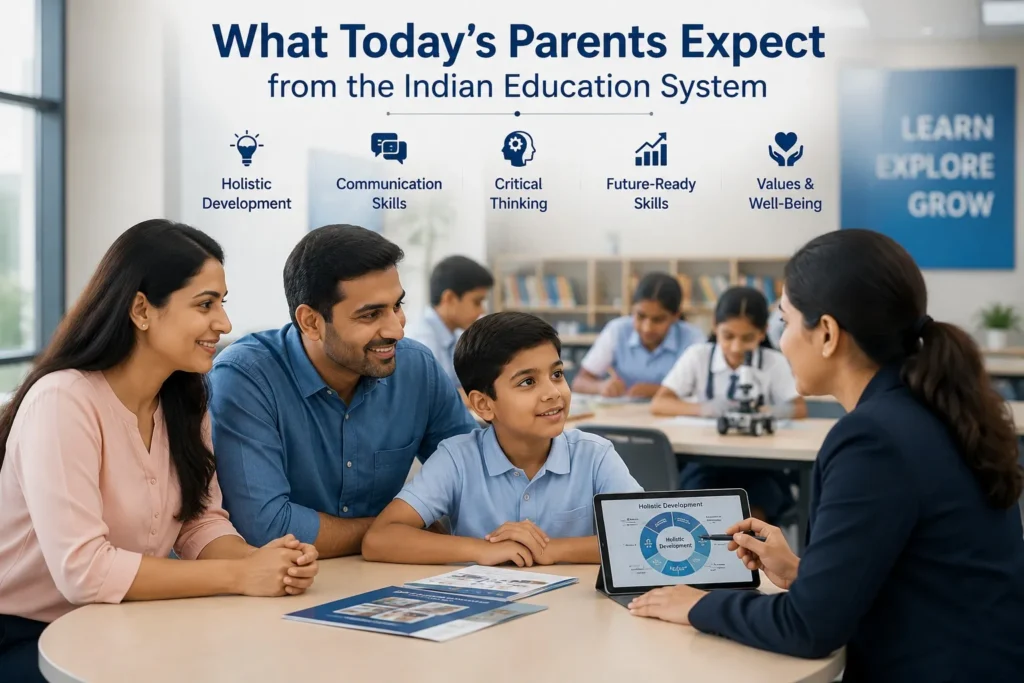
Table of Contents
Why Parents' Expectations Are Changing
The world children are growing up in today is very different from the one their parents experienced.
Technology has transformed the way people work, communicate, and learn. New careers are emerging every year, while many traditional roles are changing. As a result, parents realise that their children will need much more than academic knowledge to succeed in the future.
Success today depends on qualities such as confidence, adaptability, creativity, communication, and the ability to solve problems. Parents understand that these abilities cannot be developed by memorising textbooks alone. They need schools that encourage children to think independently, explore ideas, and apply what they learn in real-life situations.
Parents are also paying closer attention to their children’s emotional well-being. They want schools that help students enjoy learning, build confidence, manage challenges, and develop positive relationships with teachers and classmates.
Instead of asking only, “Will my child score good marks?” many parents now ask:
- Will my child enjoy learning?
- Will they become confident and independent?
- Will school prepare them for future careers?
- Will they develop strong values and character?
- Will they be able to adapt to a changing world?
These questions reflect a broader understanding of what quality education should provide.
The Indian Education System Is Evolving
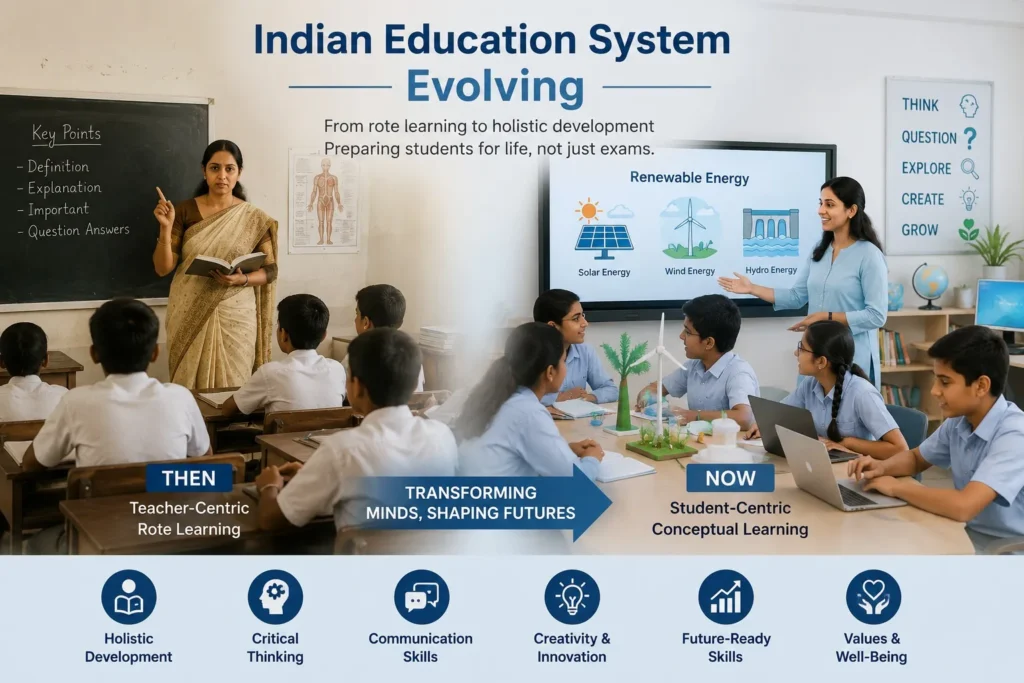
The Indian Education System has evolved significantly in recent years, with a growing focus on helping students understand concepts, think critically, and apply their learning in everyday life. A major step in this transformation is the National Education Policy (NEP) 2020, which encourages schools to move beyond rote learning and create more engaging, student-centred classrooms. Today, many schools are helping students build confidence, improve communication, and connect classroom lessons with real-life experiences. This shift reflects an important goal of the Education System in India-to prepare children not only for examinations but also for the opportunities and challenges they will face throughout life.
Why the Future of Indian Education Looks Different
The Future of Indian Education is being shaped by changing student needs, technological progress, and evolving career opportunities.
Children entering school today will graduate into a world where continuous learning will be essential. Many of the careers they pursue may not even exist today. Because of this, schools must focus on helping students become adaptable learners who are comfortable with change.
The future of education is expected to place greater emphasis on:
- Independent thinking
- Creative problem-solving
- Communication skills
- Collaboration
- Leadership
- Digital awareness
- Emotional well-being
- Lifelong learning
These are not separate subjects. They are abilities that help students apply their knowledge effectively throughout their lives.
Parents increasingly recognise that schools play a crucial role in developing these qualities alongside academic excellence.
What Today's Parents Expect from the Indian Education System
Parents today expect schools to go beyond completing the syllabus. They want learning to be meaningful, engaging, and relevant to the real world. Here are some of the biggest expectations shaping the Education System in India today.
1. Education Beyond Marks and Examinations
Academic success continues to matter, but parents no longer believe that marks alone define a child’s potential. They want schools to help children understand concepts instead of simply memorising information for examinations. Deep understanding allows students to apply knowledge with confidence, making learning more meaningful and enjoyable. When children develop genuine curiosity, they become lifelong learners rather than students who study only to score well.
2. Critical Thinking Instead of Memorisation
One of the biggest expectations parents have today is that schools should teach children how to think, not simply what to remember. Children should be encouraged to ask questions, explore different ideas, analyse situations, and arrive at their own conclusions. Critical thinking helps students become confident decision-makers who can solve problems both inside and outside the classroom. Whether choosing a future career, understanding current events, or making everyday decisions, this ability remains valuable throughout life.
3. Learning That Connects with Real Life
Parents appreciate learning that feels practical and meaningful. When students can relate classroom concepts to everyday experiences, they understand lessons more deeply and retain knowledge for longer. Simple classroom discussions, observations, experiments, projects, field visits, and collaborative activities help students see how education connects with the world around them. Learning becomes more engaging when children understand not only what they are learning but also why it matters.
4. Strong Communication Skills
Knowledge becomes far more valuable when students know how to express it. Parents expect schools to help children develop confidence in speaking, listening, writing, and presenting their ideas clearly. Good communication improves classroom participation, strengthens friendships, and prepares students for higher education and future careers. Children who communicate confidently are more likely to share ideas, ask questions, and participate actively in learning.
5. Problem-Solving Skills That Build Confidence
Life rarely presents problems with simple answers. Every day, children face situations that require them to think, make decisions, and adapt. Parents expect schools to help students develop these practical problem-solving skills from an early age. Instead of providing ready-made answers, schools should encourage children to analyse situations, explore different solutions, and learn from their experiences. This approach builds confidence and teaches students that making mistakes is a natural part of learning. When students become effective problem-solvers, they are better prepared to face academic challenges as well as real-life situations with resilience and confidence.
6. Emotional Intelligence Matters as Much as Academic Success
Academic knowledge is important, but parents also want their children to grow emotionally. Children experience success, disappointment, friendships, disagreements, and pressure throughout their school years. Learning how to understand emotions and respond positively to different situations is just as important as learning mathematics or science. Parents increasingly value schools that help children:
- Build self-confidence.
- Handle challenges calmly.
- Show empathy and kindness.
- Respect different opinions.
- Develop healthy relationships.
When emotional well-being is given importance, children become happier learners and more responsible individuals.
7. Leadership and Responsibility from an Early Age
Leadership is no longer seen as a quality reserved for a few students. Parents want every child to have opportunities to develop confidence, responsibility, and decision-making skills. Simple responsibilities such as leading a classroom activity, participating in student councils, organising school events, or working in teams help children become more accountable and self-reliant.
These experiences teach valuable life lessons that cannot be learned from textbooks alone. Children learn how to communicate, collaborate, solve conflicts, and take ownership of their actions. Leadership developed during school years often becomes the foundation for success later in life.
8. Creativity Should Be Encouraged Every Day
Every child is naturally curious and creative. Parents expect schools to nurture that creativity instead of limiting learning to memorising facts. Creativity is not limited to drawing or music. It is also reflected in how children think, solve problems, ask questions, and discover new ideas. Schools that encourage imagination help students become confident thinkers who are willing to explore different possibilities and express themselves freely. Creativity also helps children enjoy learning because it allows them to participate actively rather than simply follow instructions.
9. Responsible Use of Technology
Technology is an important part of modern education, and parents want children to use it with confidence and responsibility. Schools should help students find reliable information, think critically about online content, stay safe in the digital world, and maintain a healthy balance between screen time and real-life experiences. The goal is to prepare children to use technology wisely, responsibly, and ethically.
10. A Safe and Positive Learning Environment
Parents know that children learn best when they feel safe, respected, and supported. A positive school environment encourages students to ask questions, participate confidently, and express their ideas without fear. When children feel welcomed, valued, and included, they enjoy learning more, build stronger relationships, and grow into confident individuals.
11. Values and Character Should Be Part of Everyday Learning
Parents want schools to shape not only successful students but also responsible and compassionate individuals. Qualities such as honesty, respect, kindness, integrity, gratitude, discipline, and responsibility help children make better decisions and build meaningful relationships. When strong values are nurtured alongside academics, children are better prepared for life.
12. A Strong Partnership Between Schools and Parents
A child’s education is most effective when schools and parents work together. Today’s parents expect regular communication, constructive feedback, and opportunities to stay involved in their child’s learning journey. By working as partners, schools and families can provide consistent support that helps every child grow academically, socially, and emotionally.
The Common Goal Parents Share
Although every family has different aspirations, most parents want the same outcome. They want their children to become capable, confident, and compassionate individuals who are prepared for whatever the future brings.
This is why expectations from the Indian Education System have expanded beyond examinations and academic achievement. Parents are looking for schools that help children develop life skills, confidence, curiosity, strong values, and a love for continuous learning. Education today is no longer only about preparing students for the next examination. It is about preparing them for the next stage of life.
The Future of Indian Education
The Future of Indian Education is no longer centered only on academic achievement. It is about helping students become adaptable, confident, and prepared for a world that continues to evolve. As technology, industries, and careers change, education must also change to meet new expectations.
Parents today want schools to focus on developing well-rounded individuals who can think independently, communicate effectively, and make informed decisions. The future of the Education System in India lies in creating learning experiences that encourage curiosity, creativity, collaboration, and lifelong learning.
The National Education Policy (NEP) 2020 has already started this transformation by promoting conceptual understanding, flexibility in learning, and the development of essential life skills. While this journey will take time, it represents an important step towards making education more meaningful for every child.
The goal is not simply to produce students who perform well in examinations but individuals who are prepared to face real-life challenges with confidence and responsibility.
The expectations of today’s parents clearly show that education is changing. While academic excellence remains important, it is no longer the only measure of success.
Parents want schools that prepare children for life by developing confidence, curiosity, communication, responsibility, and strong values alongside academic knowledge. They expect the Indian Education System to help students become adaptable learners who are ready to succeed in a rapidly changing world.
The Education System in India is already moving in this direction through educational reforms and a growing focus on meaningful learning. As schools continue to embrace these changes, they have an opportunity to nurture students who are not only knowledgeable but also compassionate, resilient, and future-ready.
The true purpose of education is not simply to prepare children for examinations—it is to prepare them to lead meaningful lives, contribute positively to society, and continue learning long after they leave the classroom.
Share this article
Frequently Asked QUESTIONS
Q1. What do today's parents expect from the Indian Education System?
Today’s parents expect the Indian Education System to provide more than academic knowledge. They want schools to develop confidence, communication skills, critical thinking, leadership, strong values, and practical life skills that prepare children for the future.
Q2. How is the Education System in India changing?
The Education System in India is gradually moving beyond rote learning by focusing more on conceptual understanding, student participation, practical application, and holistic development through reforms like NEP 2020.
Q3. Why are life skills important in school education?
Traditional learning often focuses on memorization, while Activity-Based Learning encourages students to actively participate, explore concepts, and apply knowledge in practical situations.
Q4. How can parents support their child's education?
Examples include science experiments, storytelling, educational games, role-play, group discussions, art and craft, STEM activities, field visits, and project-based assignments.