 2026-27 Admissions Open – Enrol Your Child Today!
Importance of Mother Tongue in Early Childhood: The Role of Hindi and Indian Languages
Before a child learns to read, write or solve an equation, they have already started learning to speak. They ask questions, imitate sounds, tell stories, describe what they see and make sense of the world around them.
Often, the language through which these first discoveries happen is the language spoken at home.
A mother tongue is therefore much more than a means of communication. It is often the language in which a child first hears a story, expresses an emotion, asks “why?”, talks to a grandparent and understands everyday experiences. It becomes one of the first tools through which children organise their thoughts and connect with the people around them.
This is why the importance of mother tongue in early childhood deserves attention. When children are familiar with the language used for learning, they can communicate more comfortably and participate with greater confidence.
In India, children grow up with many different languages. Hindi is one of them, along with languages such as Bengali, Marathi, Gujarati, Tamil, Telugu, Kannada, Malayalam, Punjabi, Assamese and many others. Understanding the importance of Indian languages can help schools and families create a richer learning environment.
The question is not whether one language should replace another. The more important question is: how can we give children strong linguistic foundations while helping them become confident multilingual learners?
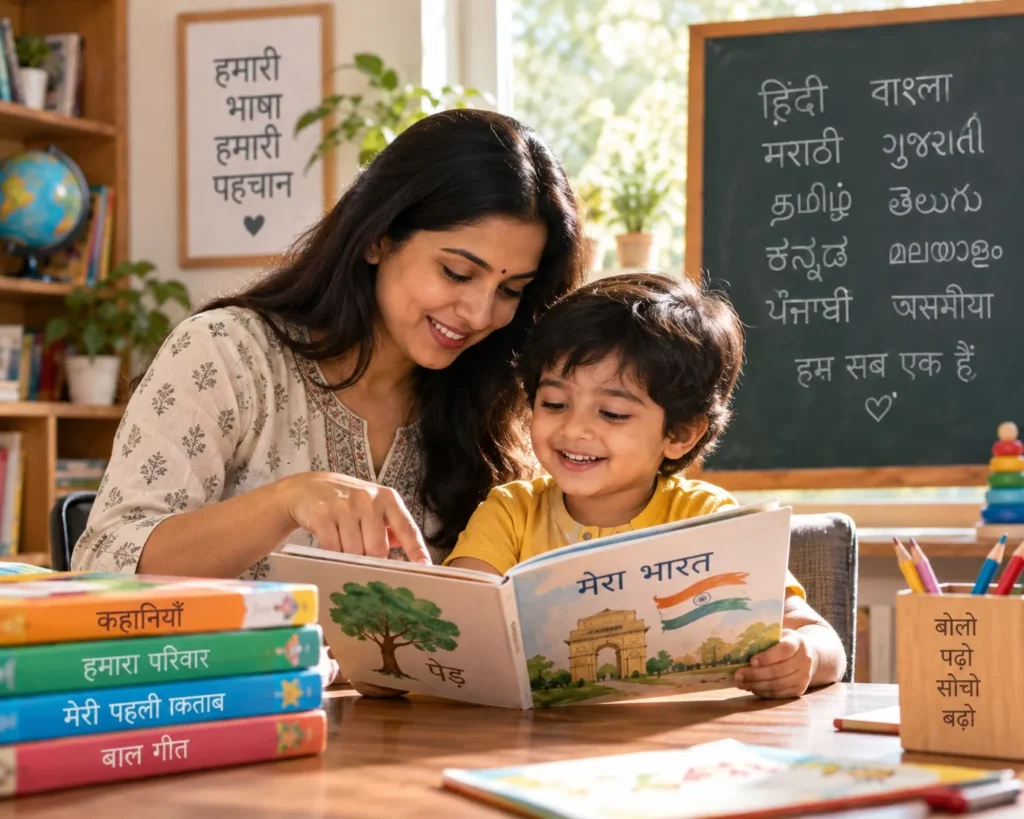
Table of Contents
Language Doesn't Just Build Vocabulary. It Builds Thinking.
When a child is learning through a familiar language, they do not have to spend all their attention figuring out what the words mean. They can focus more fully on the idea behind those words.
Imagine a child learning about sharing. A familiar story can help them discuss what a character did, why the character made a particular choice and what they might have done differently. The learning is no longer limited to remembering a definition. The child is thinking, questioning and making connections.
This is one reason the mother tongue can play an important role in early childhood learning. A familiar language gives children a comfortable space to experiment with ideas. They can make mistakes, try different words, ask follow-up questions and explain something in their own way.
These are small moments, but they matter. Confidence in expressing an idea is closely connected with a child’s willingness to participate in learning. The goal, therefore, should not be to keep children within one language. It should be to give them a strong foundation from which they can explore more languages and more ways of communicating.
Why Mother Tongue Matters in Early Childhood
Early childhood is an important stage for language development. Children are constantly learning new words, understanding meanings, asking questions and expressing emotions. A familiar language can make this process more comfortable. Children can explain what they think, ask for help, share stories and interact with others using words they already understand.
The mother tongue can also help children connect learning with their daily lives. A simple story, conversation or example in a familiar language can make a new idea easier to discuss. This does not mean children should learn only one language. Instead, a strong foundation in the familiar language can support their overall communication and make it easier to develop additional language skills.
The Importance of Hindi and Indian Languages in Education
The importance of Hindi language in education can be understood through its role in communication, literature and cultural connection. For children who speak Hindi at home, learning and expressing ideas in Hindi can provide a familiar starting point. At the same time, India is a multilingual country. Every Indian language carries its own stories, traditions, expressions and cultural knowledge.
The importance of Hindi and Indian languages in education is therefore not about choosing one language over another. It is about giving children opportunities to understand, use and value the languages they know. When children see their language represented in books, stories, classroom activities and conversations, learning can feel more connected to their everyday experiences.
Benefits of Learning in the Mother Tongue
Language is closely connected with how children communicate and participate in learning. Using a familiar language can help children express themselves without worrying about finding unfamiliar words.
It can also support language development during the early years. Children can learn new vocabulary, understand sentence structures and develop the confidence to communicate their ideas.
For example, a child may understand the idea of sharing more easily when it is explained through a familiar story or conversation. Later, the same concept can be discussed in another language.
This approach can also encourage communication skills. Children who feel comfortable expressing their thoughts are more likely to ask questions, participate in discussions and share their experiences.
Does Learning Hindi Affect English Learning?
This is a question many parents naturally have.
In a world where English is important for higher education, careers and global communication, parents may worry that giving too much space to Hindi or another Indian language could slow down English learning.
The two do not have to compete.
Children can learn more than one language, and the early years provide many opportunities to build multilingual skills. Learning in a familiar language can help children develop the broader foundations of communication-listening, understanding, vocabulary, storytelling and expressing ideas—which can then support learning another language.
The goal is not Hindi versus English.
The goal is confident communication in more than one language.
A child can discuss an idea in Hindi and gradually learn to express the same idea in English. They can read a Hindi story today and an English story tomorrow. They can speak with their grandparents in one language and participate in school activities in another.
Multilingualism does not have to mean choosing sides. It can mean giving children more than one way to understand and connect with the world.
Hindi and Child Development Through Stories, Poems and Conversation
The connection between Hindi and child development can be seen in simple everyday activities.
Storytelling encourages children to listen, imagine and predict what might happen next. Poems and rhymes introduce rhythm, sounds and new vocabulary. Conversations allow children to explain their experiences and learn how to take turns while speaking.
Hindi literature offers a rich collection of stories, poems, folk tales and other forms of expression that can make these experiences engaging for children.
The activity does not need to be complicated.
A parent can read a short Hindi story before bedtime and ask:
“What do you think the character should have done?”
“Why do you think they behaved that way?”
“What would you have done?”
A teacher can use a familiar poem to begin a conversation about emotions, nature or relationships.
These conversations are where language becomes more than vocabulary. Children learn to interpret, question, imagine and express their own point of view.
How Parents Can Encourage Language Learning at Home
Language development does not require a special timetable.
Everyday life provides countless opportunities.
Parents can talk to children about their day, ask them to describe something they noticed, read stories together, sing songs or encourage them to retell a story in their own words.
Open-ended questions are particularly useful.
Instead of asking, “Did you enjoy the story?”, try asking, “Which part did you like most?” or “What would you change about the ending?”
And when a child makes a language mistake, there is no need to correct every sentence immediately. Listening first and gently modelling the correct expression can help children feel comfortable communicating.
Families can also share traditional stories, songs, poems and expressions from their own language. These small moments tell children that their language is not simply something they speak—it is part of who they are and where they come from.
What Schools Can Do
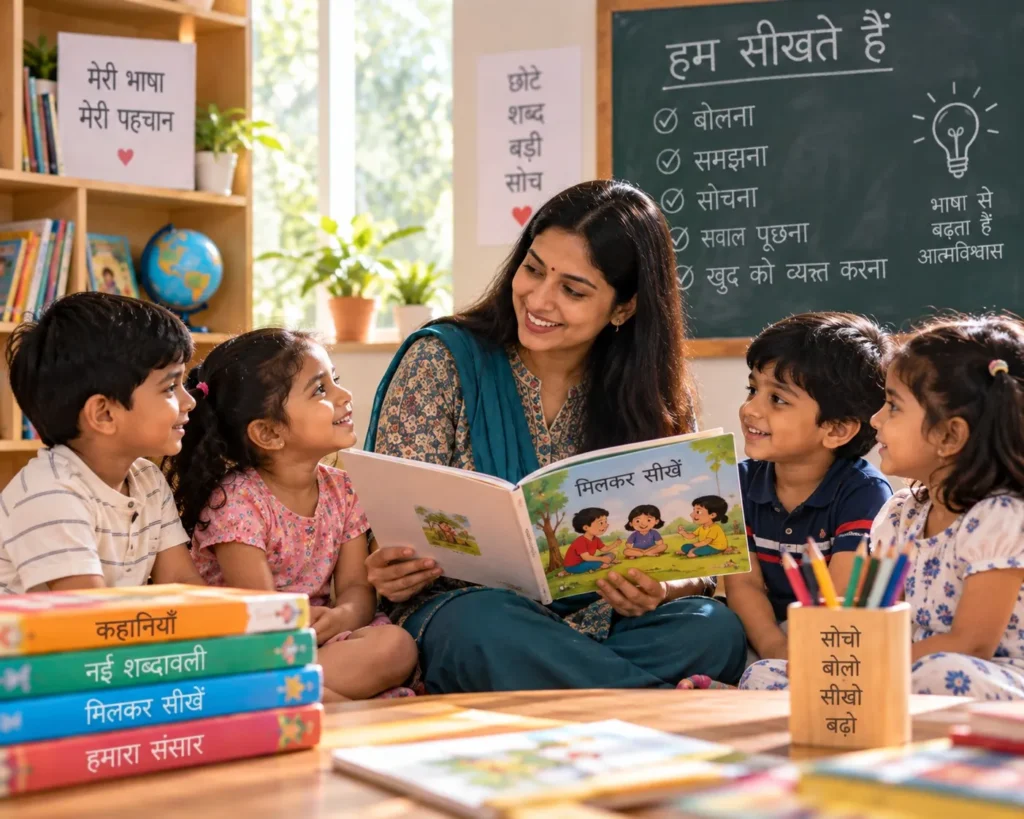
The responsibility for language development does not sit with families alone. Schools can create environments where children encounter multiple languages naturally and respectfully.
This could mean offering age-appropriate stories in Hindi and other Indian languages, encouraging children to share stories from home, using familiar examples while introducing new concepts, and creating opportunities for students to speak, read and express themselves in different languages.
The objective is not to turn every classroom into a language class. It is to make language a natural part of learning.
When children see their home languages respected at school, the distance between home and school becomes smaller. They can bring more of their experiences into the classroom-and that can enrich learning for everyone.
Preserving Language, Building Strong Foundations
Being future-ready does not mean leaving one’s linguistic and cultural roots behind. In fact, children can be encouraged to do both: develop strong connections with their mother tongue and build proficiency in additional languages.
Hindi has an important place in India’s cultural and educational landscape, but so do the many other languages spoken across the country. Each language gives children another way to tell a story, express an emotion, understand a family tradition or connect with another person.
The role of education is not to decide which language matters more. It is to help children become confident enough to use language as a tool for learning, thinking and connecting.
This Hindi Diwas, the message is simple: when children are encouraged to value their language, they also learn to value their voice.
Share this article
Frequently Asked QUESTIONS
Q1. What is the importance of mother tongue in early childhood?
The mother tongue can help children communicate comfortably, express their thoughts and connect learning with familiar experiences. It can also support early language development and confidence.
Q2. How does Hindi help in child development?
Hindi can support vocabulary, communication, storytelling and creative expression for children who use or learn the language. Hindi stories and poems can also introduce children to different ideas and cultural experiences.
Q3. Why are Indian languages important in education?
Indian languages connect children with their families, communities and cultural traditions. Using familiar languages can also make communication and learning more meaningful for young children.
Q4. Can children learn Hindi and English together?
Yes. Children can learn multiple languages as part of their education. Hindi and English can be introduced together through age-appropriate conversations, stories, reading and classroom activities.
Q5. How can parents encourage Hindi language learning at home?
Parents can encourage learning Hindi through everyday conversations, Hindi stories, poems, songs, picture books and storytelling. Making language activities enjoyable can help children develop confidence naturally.