 2026-27 Admissions Open – Enrol Your Child Today!
Why STEM Labs Matter in Shaping the Future of Schools
Classrooms today are changing. Students need more than textbooks and blackboards to understand the world around them. As technology becomes part of everyday life, schools must help children learn how to think logically, solve problems, ask questions, and adapt to change.
This is where STEM labs can make a meaningful difference. By bringing Science, Technology, Engineering, and Mathematics together in a practical learning space, STEM labs allow students to explore ideas by doing, testing, building, and discovering.
For K-12 schools, this approach can make complex concepts easier to understand while helping students develop skills that are useful both inside and outside the classroom.
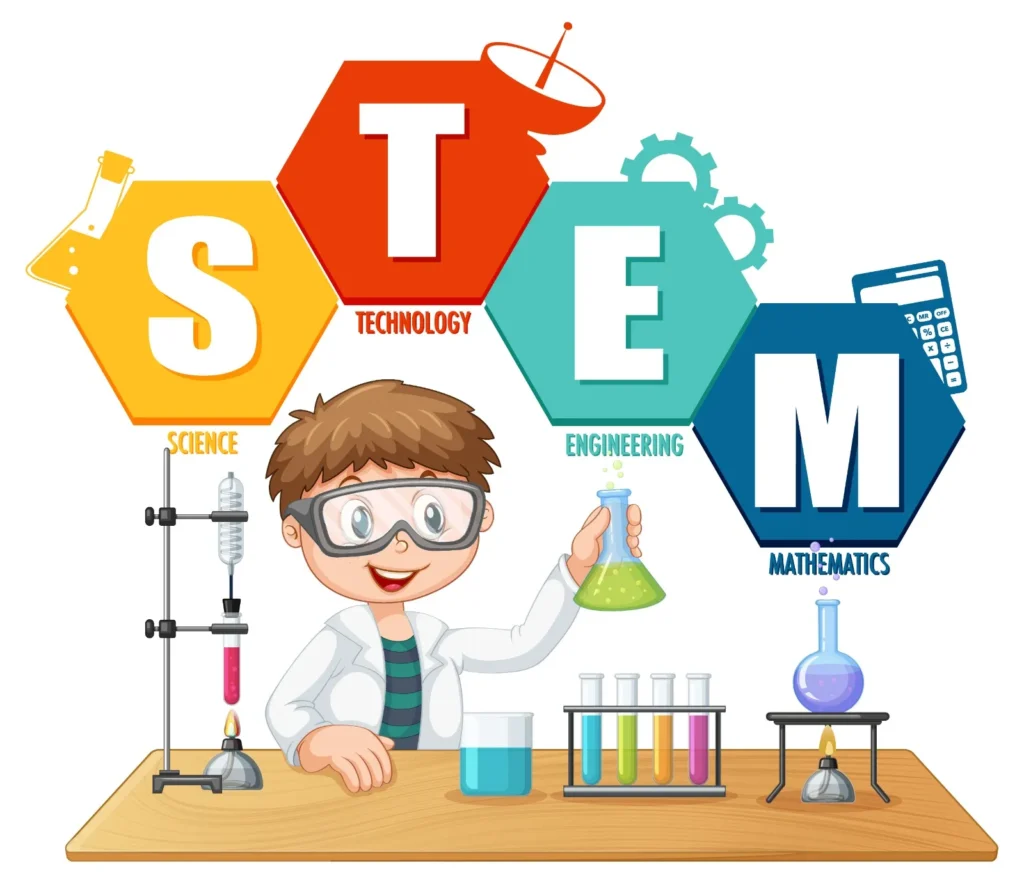
Table of Contents
What Is a STEM Lab in K-12 School Education?
A STEM lab is a dedicated space where students explore Science, Technology, Engineering, and Mathematics through practical activities. Instead of learning only from textbooks, students can experiment, build models, test ideas, and observe how different concepts work.
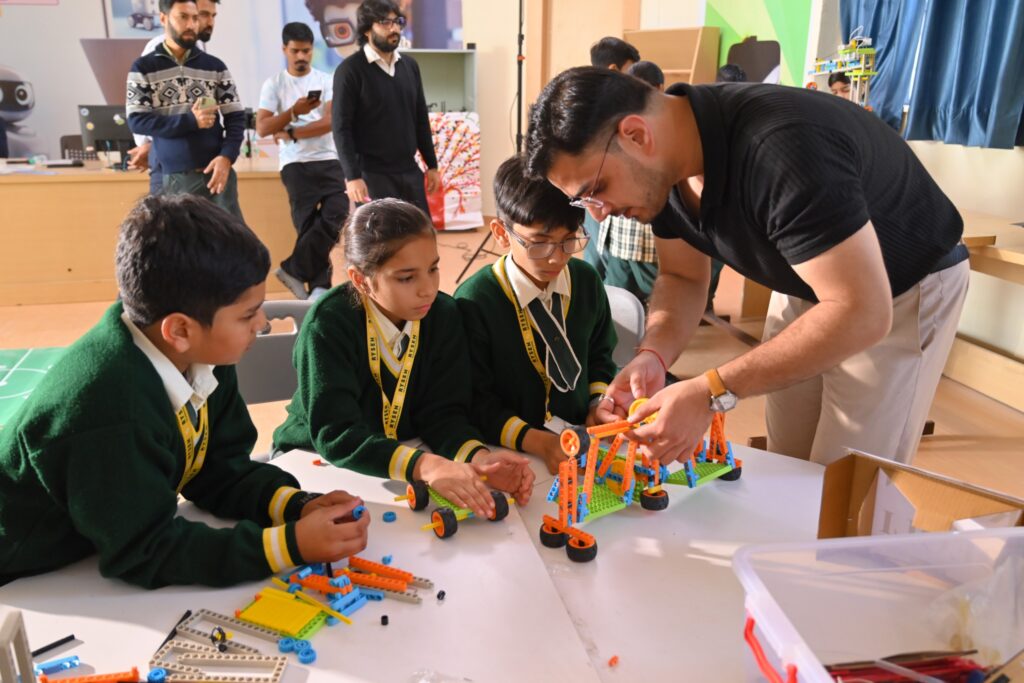
Activities in a STEM lab may include simple science experiments, model-making, design challenges, basic coding, measurements, and problem-solving tasks. These activities help students connect classroom lessons with real-world situations.
Unlike a traditional classroom, a STEM lab gives students more opportunities to ask questions and find answers through exploration. They can make mistakes, try again, and learn from the results. This makes learning more active while building logical thinking, creativity, teamwork, and confidence.
For younger students, early exposure to STEM can also create curiosity about how things work. As they grow, these experiences can provide a strong foundation for more advanced learning.

How STEM Labs Improve Concept Clarity
Some concepts are difficult to understand when students only read about them. A STEM lab gives them an opportunity to see those concepts in action.
A science experiment can make a scientific principle easier to understand. A measurement activity can make mathematics more practical. A design project can show students how different ideas work together to solve a problem.
When students can see, build, test, and observe, abstract ideas often become easier to understand. This practical experience can also make challenging subjects feel less intimidating
Encouraging Problem-Solving and Critical Thinkin
STEM labs naturally encourage students to think about problems and find possible solutions. Instead of receiving an answer immediately, students can be given a challenge and asked to work out how to solve it. They may test several ideas, discover that something does not work, and then try a different approach.
This teaches children that mistakes are not something to fear. They are opportunities to learn and improve. Over time, students develop patience, logical thinking, decision-making, and resilience. These skills are valuable not only in academics but also in everyday life.
Building Curiosity and Creativity from an Early Age
STEM learning does not need to begin in senior classes. Younger students can also benefit from simple experiments, building activities, puzzles, and age-appropriate technology.
At an early age, children naturally ask questions such as Why does this happen?, How does this work?, and What happens if I change it? A good STEM lab gives them the opportunity to explore these questions. This encourages children to remain curious, try new ideas, and become comfortable with discovering things on their own. Early exposure can also help students develop a positive attitude towards subjects that they may otherwise find difficult.
Preparing Students for a Changing Future
The future workplace will continue to change as technology develops. Students will need to learn new tools, understand new ideas, and adapt to different situations throughout their lives.
STEM labs can help prepare them by developing skills such as logical thinking, creativity, collaboration, problem-solving, and adaptability. These abilities can support students across many areas. They may be useful in science and technology careers, but they are equally valuable in business, design, communication, entrepreneurship, and other fields.
The aim is not to decide a child’s career at an early age. Instead, it is to give students the confidence and skills to explore different possibilities.
STEM Labs Support Holistic Student Development
The benefits of STEM labs go beyond academic learning. Students also develop important personal and social skills while working on practical tasks. Group projects encourage teamwork and communication. Presenting a project helps students explain their ideas clearly. Taking responsibility for a task can build leadership and confidence.
Students also learn to listen to different opinions, share responsibilities, and work towards a common goal. In this way, STEM labs can contribute to the overall development of students while supporting their academic growth.
The Teacher's Role in Effective STEM Learning
A STEM lab is only as effective as the learning experience created inside it. Teachers play an important role in making these activities meaningful. Rather than simply giving students instructions and answers, teachers can guide them with questions and encourage them to explore different possibilities.
For example, instead of telling students why a model failed, a teacher can ask, “What do you think went wrong?” or “What could you change?”
This approach encourages students to think independently while still giving them the support they need. A knowledgeable and encouraging teacher can turn a simple activity into a valuable learning experience.
Creating a Safe Environment for Exploration
Students learn better when they feel comfortable asking questions and making mistakes. A successful STEM lab should therefore be a place where students can try an idea, see it fail, and try again without feeling embarrassed. Teachers can encourage students to focus on the learning process rather than only the final result.
When children feel supported, they become more willing to experiment, share their ideas, and take initiative. This creates a positive environment where curiosity and creativity can grow naturally.
Why STEM Labs Matter in K-12 Education Today
STEM labs can help schools create a stronger connection between classroom knowledge and practical understanding. They give students opportunities to explore concepts, solve problems, collaborate with classmates, and learn from their experiences. For K-12 education, this is especially valuable because students are developing their learning habits, interests, and confidence throughout these years. A well-planned STEM lab does not replace classroom teaching. Instead, it complements it by giving students another way to understand and apply what they learn.
Learning That Prepares Students for Life
STEM labs are more than an addition to school infrastructure. When thoughtfully integrated into education, they can become spaces where students learn to question, explore, create, solve, and improve.
The greatest value of STEM learning is not simply knowing how to build a model or complete an experiment. It is developing the confidence to face a problem, explore possible solutions, learn from mistakes, and keep trying.
For schools, investing in STEM labs means creating more opportunities for students to connect knowledge with real life. For students, it means learning in a way that can prepare them not only for examinations and higher education, but also for the challenges and opportunities ahead.
A strong STEM learning environment can help schools shape students who are curious learners, thoughtful problem-solvers, confident communicators, and adaptable individuals-ready to keep learning as the world around them changes.
Share this article